


Your GenAI pilot worked. The demo landed, the steering committee nodded, and the model did exactly what the vendor promised it would. Eighteen months on, the same committee wants to know why none of that promise shows up in the P&L. The model isn’t the problem. The workforce sitting around it was never trained to use it, question it, or build it into how work actually gets done.
That’s the answer, in short: GenAI upskilling for enterprises is what turns a working pilot into measured business value. Not a bigger pilot. Not a better model. A deliberate layer of role-based AI literacy and adoption tracking sitting between the technology and the P&L line a CXO actually has to defend.
The Pilot-to-Value Gap Is Wider Than Most CXOs Assume
Enterprises aren’t short on GenAI pilots. Most large organisations in India and the GCC have run several: a copilot for customer service, a drafting assistant for legal, a code assistant for engineering. The gap shows up after the pilot, when the tool has to earn its budget line in production.
MIT NANDA’s State of AI in Business 2025 report, based on interviews and surveys across more than 150 enterprise deployments, found that 95 percent of generative AI pilots fail to deliver measurable profit-and-loss impact within the organisations running them. That’s not a model quality problem. The report points squarely at organisational learning and workflow integration as the differentiator between the small number of programmes that scale and the large majority that don’t.
Boards don’t fund a second pilot for the same use case. They ask why the first one didn’t stick. For a CXO or BU head, that question lands directly. The AI investment usually sat under a business unit’s P&L, not a lab budget.
The Bottleneck Sits in the Workforce, Not the Model
A pilot runs with a data science team, a vendor solutions engineer, and a handful of enthusiastic early adopters hovering nearby to fix anything that breaks. Production runs with none of that. It runs with a claims processor who’s never had a reason to question an AI-generated summary, a mid-level manager who has to sign off on outputs she doesn’t fully trust, and a compliance reviewer who wasn’t in any of the pilot workshops.
Nobody built literacy for those people. The rollout plan covered licences, integrations, and a change-management email. It didn’t cover what “AI-capable” means for a frontline agent versus a functional head versus someone approving AI output for a regulator. Without that distinction, three things happen on a predictable loop: people avoid the tool because they don’t trust it, people over-trust it because nobody taught them where it fails, or people use it exactly the way they used the old process, quietly working around the new capability instead of through it.
None of that shows up as a technology failure in a status report. It shows up as flat usage numbers and a business case that quietly disappears from next year’s budget conversation.
IMPACT 360™: Locating Exactly Where the Investment Is Stuck
This is where most measurement conversations go wrong. Kirkpatrick’s model (Reaction, Learning, Behaviour, Results) still tells you whether training landed. It was built for an era where the finish line was the classroom exit survey. ProBits built IMPACT 360™ as an extension of that logic for a business-impact era, not a replacement for it, because a CXO doesn’t need to know if employees liked the AI workshop. He needs to know if the AI investment is producing commercial value, and if not, exactly where in the chain it broke down.
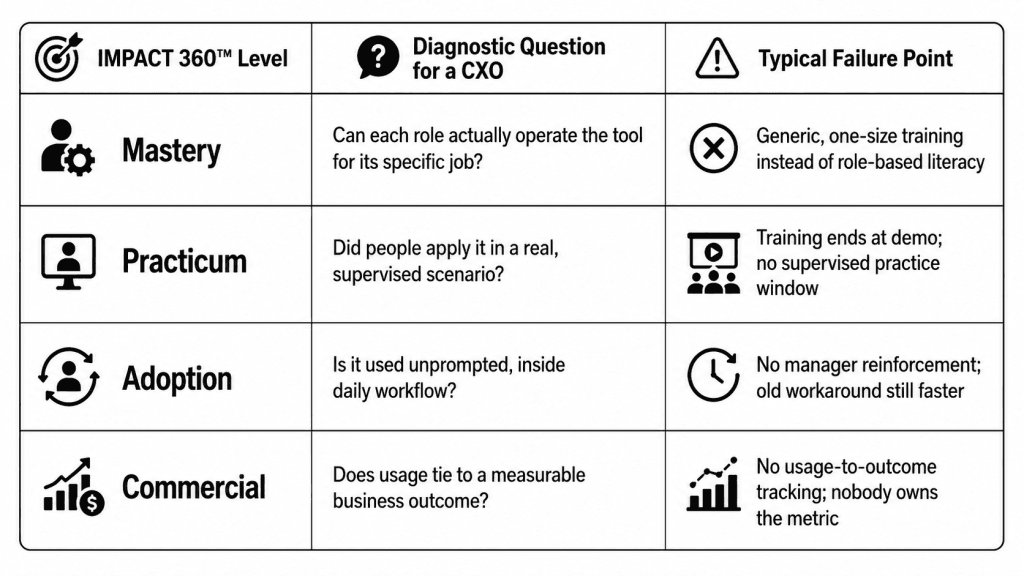
IMPACT 360™ runs across six levels: Inspiration (the workforce gets curious about the tool), Mastery (people can actually operate it), Practicum (they apply it in a safe, supervised setting), Adoption (it’s embedded in daily work, unprompted), Commercial (it produces tangible business value), and Transformation (the organisation becomes measurably more resilient and future-ready because of it).
Nearly every stalled GenAI rollout sits between Practicum and Adoption. Employees completed a training session, so Mastery is checked. Some ran a supervised test case, so Practicum is checked too. But the tool never became something people reach for without being told to, and it never got instrumented well enough to show up as Commercial value on anyone’s dashboard. That’s not a training completion problem. It’s an adoption design problem, and it’s exactly where a role-based capability layer and a measurement discipline need to sit.
 What a Role-Based AI Literacy Program for Employees Actually Looks Like
“Train everyone on the tool” is not a plan. It’s the reason most rollouts flatline at Mastery. A working AI literacy program for employees is tiered by what each role is actually being asked to do with the technology:
– Frontline users need practical fluency: what to trust, what to check, how to spot a wrong output before it reaches a customer.
– Managers and reviewers need judgment training: how to evaluate AI-assisted work from their team, not just consume it themselves.
– Function-specific power users (finance, legal, customer operations) need depth on the failure modes specific to their domain, because a hallucinated contract clause and a miscoded transaction fail differently.
– Technical and build teams need the deeper skills to extend, fine-tune, or govern the tooling as it scales beyond the pilot use case.
Enterprise AI training programs that skip this tiering end up training everyone to the lowest common need, which under-serves the technical teams and over-serves people who only needed thirty minutes of practical guidance. ProBits designs this layer through its Diagnose → Design → Deliver → Measure model, starting with which roles touch the AI workflow and where the risk of misuse or non-use is highest, not with a generic course catalog.
Structured Adoption Tracking: Turning “People Are Using It” Into a Number
Usage dashboards from the AI vendor tell you login counts. They don’t tell you whether the finance team is actually using the tool to close books faster, or whether it’s open in a browser tab nobody touches after week two. Structured adoption tracking means defining, before rollout, what “adopted” looks like for each role: frequency of use tied to a real task, a quality check on the output, and a link from that usage pattern to a business metric the BU head already reports on, whether that’s cycle time, error rate, cost per case, or revenue per rep.
This is the missing half of most AI governance conversations. Organisations spend heavily on model governance (access controls, data policy, audit trails) and almost nothing on adoption governance: who owns the metric that proves the tool is earning its keep, and what happens when it doesn’t hit that mark by month four. Without that ownership, the Commercial level of IMPACT 360™ never gets measured, and an investment that might genuinely be working gets read as a failure simply because nobody built the number that would prove otherwise.
Where This Goes Next
The organisations that will separate themselves over the next few budget cycles aren’t the ones that ran the most pilots. They’re the ones that built the capability layer to carry a pilot into production, role by role, with a way to prove it’s working before the board asks. That work doesn’t get easier by waiting for the next model release. It gets built once, deliberately, and then reused across every AI initiative that follows.
If your organisation has GenAI pilots that never quite crossed into production value, ProBits can help you diagnose exactly where the stall sits, at Adoption or at Commercial, and design the role-based capability layer to close it. Talk to ProBits about an IMPACT 360™ readiness assessment for your next AI rollout.