

Leadership Development Programs for Enterprises
A manager at a 3,000 person GCC in Bangalore doesn’t spend Monday mornings building a status deck anymore. An AI tool does it in four minutes. What’s left for that manager is harder: walk into a room, tell a high performer their project just got cancelled, and somehow make them want to stay anyway.
That’s the shift happening inside enterprises right now. Most leadership development programs for enterprises haven’t caught up to it. AI is eating the analytical and administrative work that used to fill a manager’s calendar and what’s left underneath is coaching a struggling performer through a hard conversation, holding trust together across a hybrid team that’s never met in person, influencing a peer function that doesn’t report to you, reading a room during a review that could go badly. No model does any of that. It runs on judgement, built through practice and feedback and getting it wrong a few times first which is exactly what structured leadership development builds, and exactly what a lot of AI budgets have quietly stopped paying for.
What AI Is Actually Taking Off a Manager’s Plate
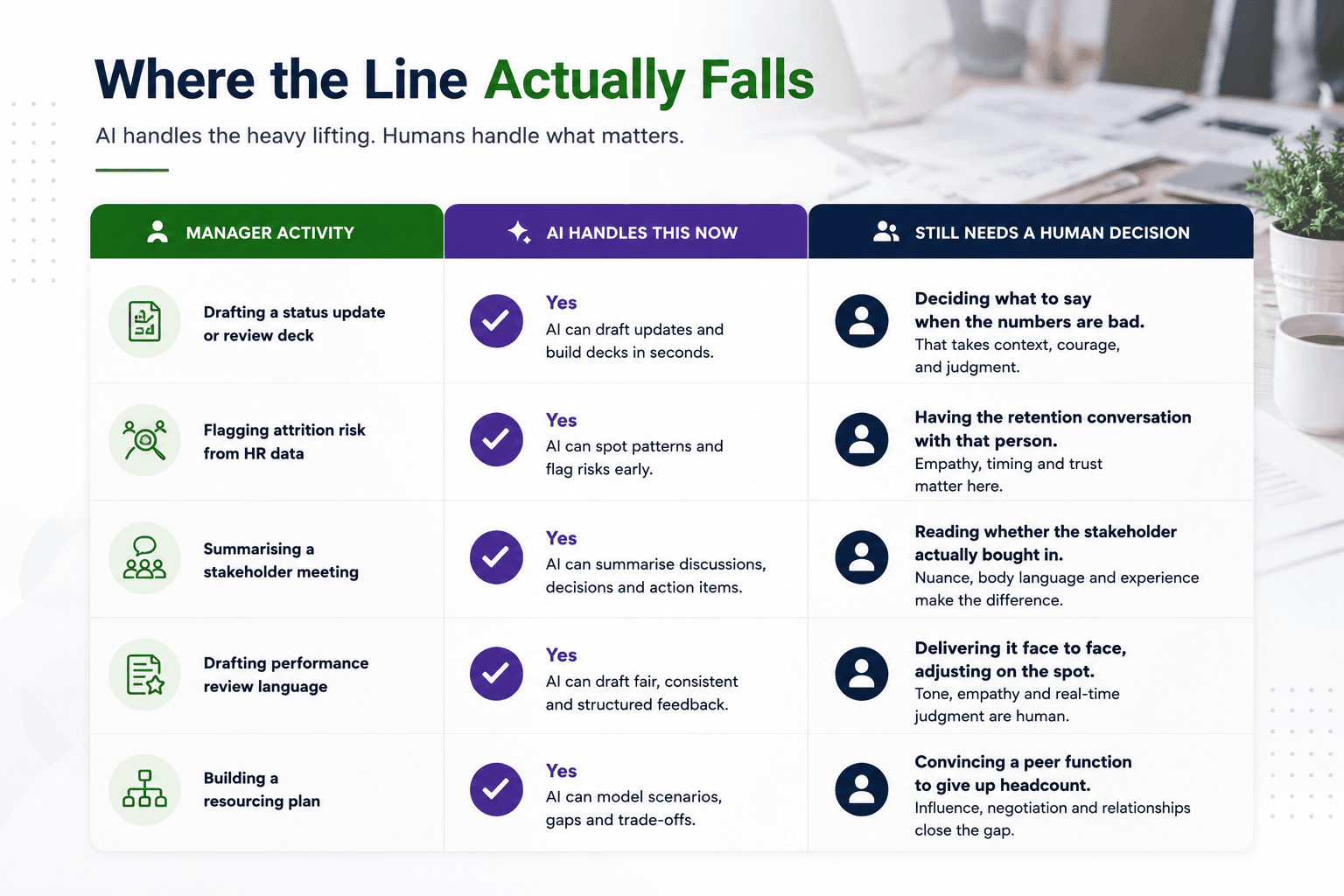
Look closely at what generative AI is doing inside management workflows today and a pattern shows up fast. It summarises meetings. Drafts performance review language. Flags attrition risk from calendar and email metadata. Builds the first cut of a resourcing plan. Answers “what happened last sprint” faster than any status call ever could.
Genuinely useful, all of it. Hours of low-judgement, high-friction admin, gone from a manager’s week. But here’s the catch: the parts of the job that used to hide behind that admin work are now exposed. A manager who was mediocre at coaching could once cover for it by being excellent at reporting. That cover is gone. The reporting runs itself now. What’s visible is whether the manager can actually develop people, resolve conflict, and hold a team together when the plan changes without warning and some of them can’t, and there’s nowhere left to hide that.
The Capabilities No Tool Can Do For a Manager
Four things sit outside what AI can meaningfully touch, and they map almost exactly onto where enterprise leadership gaps actually show up.
Coaching someone through a hard conversation
Not a scripted feedback template, but a live exchange with a person who’s underperforming, or defensive, or scared for their job, where tone and timing carry as much weight as the words themselves.
Holding trust across a hybrid or distributed team
Anyone can schedule a stand-up. Building the kind of psychological safety where a remote engineer in a satellite office flags a problem early instead of sitting on it until it’s a crisis that’s a different skill entirely, and it doesn’t show up on a dashboard.
Influencing without formal authority
Cross-functional work has outgrown the org chart. A product manager needs a security lead, a finance partner, and a regional sales head all moving in the same direction, and not one of them reports to her.
Reading the room in a high-stakes review
Knowing when to push back on a CXO, when to let a point go, when silence means agreement rather than disagreement. That’s pattern recognition built from scar tissue, not data.
ProBits builds its leadership curriculum around exactly this split. At the mid-level tier: First-Time Manager and New Manager Bootcamps, leading hybrid and distributed teams, feedback and coaching conversations, stakeholder communication, and performance coaching through career conversations. At the senior tier: influencing without authority across functions, leading high-stakes conversations and reviews,change leadership for organisations facing constant disruption, building a learning culture, succession and talent-pipeline thinking, storytelling with data for the boardroom.
Every one of those is a capability an AI tool cannot perform on a manager’s behalf. It can draft the deck. It cannot have the conversation.
The Budget Mismatch CHROs Should Be Uncomfortable With
Here’s the pattern showing up across enterprise L&D budgets this year: AI tool spend climbing fast, leadership development line items flat or shrinking to fund it. Looks efficient on a spreadsheet. It’s a mistake in practice.
The World Economic Forum’s Future of Jobs Report 2025found that leadership and social influence ranks third among the core skills employers say matter most cited by 61% of employers, behind only analytical thinking and resilience. Striking, given how fast the same report says AI and technology skills are growing. The tools keep changing. The skill that decides whether change actually lands with a workforce hasn’t moved down the list at all. If anything it’s moved up the queue, for the people who have to make transformation stick.
Here’s the part CHROs and CXOs tend to underweight: an AI rollout rarely fails because the model is weak. It fails because the manager responsible for getting a team to actually use it can’t run the change conversation, can’t coach the sceptical senior engineer through the transition, can’t tell when a team has quietly stopped trying. Cut leadership development to fund more AI tooling, and you’re starving the exact capability that decides whether the AI investment pays off. This is the same gap ProBits has documented in the GCC leadership gap, where technical excellence keeps outrunning the supply of leaders who can actually run a room.
From managing authentication to formatting responses for display, their understanding of the full stack reduces development friction and accelerates delivery.
Measuring Whether Leadership Development Programs for Enterprises Actually Work
Most enterprises measure leadership development by attendance and satisfaction scores. That tells you people showed up and liked it. It tells you nothing about whether a manager coaches differently three months later, or whether the team’s output moved at all.
ProBits’ IMPACT 360™ model was built to close that gap an honest extension of the Kirkpatrick framework across six levels: Inspiration, Mastery, Practicum, Adoption, Commercial, Transformation. See Beyond Kirkpatrick: a CFO-ready model for proving training drove commercial outcomes for the full framework. Inspiration and Mastery track engagement and knowledge gain, which is where most measurement stops today. Practicum and Adoption ask whether the capability shows up in real work: does the manager actually run the coaching conversation differently, does the team notice a change in how reviews get handled. Commercial and Transformation ask whether that behaviour change moves a number the business cares about retention on that manager’s team, cycle time on decisions that used to stall, engagement scores in the next pulse survey.
For a CHRO defending a leadership budget in front of a CFO, that distinction is the whole article. “We ran the programme” doesn’t answer “what did it change.” IMPACT 360™ is built to answer the second question, because that’s the only one the CFO is actually asking.
Building the Bench Before the Gap Shows Up
None of this argues against AI adoption. It argues for sequencing. Push AI tools into a workforce without a manager layer capable of leading people through the change, and you’re building on sand. The tools will work fine. The adoption won’t stick because the humans responsible for making it stick were never given the capability to do it.
ProBits has run this build for enterprises across India and the GCC since 2013, working through a Diagnose, Design, Deliver, Measure model rather than a fixed course catalogue. Diagnose starts with where a specific management layer is actually falling short not a generic curriculum pulled off a shelf. Design builds the intervention around that gap, drawing on a bench of 750+ consultants, SMEs, and trainers. Delivery has run across 400+ corporate training programs and 2,000+ cohorts, adding up to more than 14,000 training hours across 70+ enterprise clients. Measure closes the loop through IMPACT 360™, so leadership can see what actually changed not just what got delivered. See the full Enterprise Leadership Development in the AI Era hub for how this plays out across every management tier.
This end-to-end ownership enables smoother scaling and faster improvements.
Where This Goes Next
The enterprises that get the next three years right won’t be the ones with the most AI tools deployed. They’ll be the ones whose managers can absorb constant change, hold a team together through it, and make the call in the room that no model can make for them. That capability doesn’t show up because a tool got smarter. It gets built deliberately, the same way any other business-critical capability gets built: diagnosed, designed, delivered, measured against outcomes that actually matter to the business.
If your leadership development budget has stayed flat while your AI tooling spend climbed, that’s worth a direct conversation. ProBits works with CHROs to diagnose where a specific management layer is exposed, and build the capability before the gap shows up in retention, in a stalled transformation, or in a review that goes worse than it should have. Talk to ProBits about a capability diagnostic for your leadership bench.