


Your last GenAI town hall got a standing ovation. The CEO announced the licences, the CTO demoed the copilot, and everyone clapped. Three months later, usage dashboards show a third of the workforce still hasn’t logged in more than twice, and the ones who did mostly used it to draft emails faster. That gap between the applause and the adoption numbers is the actual problem, and it’s an expensive one: licences you’re paying for, a transformation story you can’t back with data, and a workforce that quietly concluded the mandate wasn’t for them.
Here’s the direct answer on how to upskill your workforce for GenAI without repeating this pattern: stop treating readiness as something you announce and start treating it as something you build, role by role, with adoption measured at each stage rather than assumed after a single rollout event. A CHRO who does this closes the gap between what leadership believes about AI readiness and what employees actually experience at their desk.
The confidence gap is real, and it’s measurable
Ask most leadership teams whether their people are ready for GenAI and you’ll get a confident yes. Ask the people doing the work and the answer softens fast. According to Microsoft and LinkedIn’s 2024 Work Trend Index, 79% of leaders said AI adoption was critical to stay competitive, and 66% said they wouldn’t hire someone without AI skills. Yet only 39% of employees said their company had actually given them AI training, and just 25% of companies planned to offer it that year. Sixty percent of leaders admitted their organisation lacked a clear vision and plan for AI implementation. That’s not a small gap. It’s leadership expecting a workforce to already have skills the organisation never systematically built.
This is the pattern behind most stalled GenAI rollouts: the intent is genuine, the tool is real, and the readiness is assumed rather than verified. Nobody checked.
Why a mandate isn’t a capability
A company-wide announcement tells people a tool exists. It doesn’t tell a claims processor in BFSI how to use it to cut turnaround time, or tell a retail merchandiser how to use it for demand forecasting instead of just summarising meeting notes. Those are different skills, applied to different workflows, with different risk profiles. A blanket rollout treats them as the same problem.
The result is predictable. Power users emerge organically, usually people who were already comfortable experimenting. Everyone else waits for direction that never arrives specific enough to act on, so they default to the two or three uses they can figure out alone. Adoption looks fine in the first week because curiosity carries people that far. It flattens after that because curiosity isn’t a skill.
There’s also a trust problem hiding underneath. In regulated environments, whether it’s a bank handling customer data or a manufacturer with safety-critical documentation, employees who aren’t told what’s acceptable to put into a GenAI tool will either avoid it entirely or use it carelessly. Neither outcome is the one leadership signed up for. Enablement without guardrails just moves the risk instead of removing it.
What role-based upskilling actually looks like
Role-based GenAI reskilling starts from the job, not the tool. A CTO’s engineering teams need different depth than a CXO’s frontline sales staff, and both need something different again from a CISO’s security analysts evaluating where GenAI introduces exposure. The starting question isn’t “how do we train everyone on GenAI.” It’s “what does this specific role need to do differently, and what’s stopping them right now.”
In practice that means:
– Mapping GenAI use cases to specific workflows within a function, not to job titles in the abstract
– Building capability in tiers, so a beginner in IT support and an advanced practitioner in product engineering aren’t sitting through the same session
– Pairing every skills module with the governance boundary for that role, so people know what they can and can’t feed into a model
– Running it live, self-paced, or blended depending on how distributed and time-pressed the team is, rather than forcing one format on everyone
This is where AI skills at work for teams stop being a slogan and start being a delivery plan with owners and dates attached. ProBits builds this through a Diagnose, Design, Deliver, Measure model: diagnosing the actual skill and workflow gaps role by role, designing capability paths against those gaps, delivering across the mode that fits each team, and then measuring whether the skill actually changed how work gets done. That last step is the one most rollouts skip, and it’s the one that decides whether any of this shows up in a business result.
Measuring adoption instead of attendance
Most L&D measurement stops at “did people show up and did they like it.” That’s Kirkpatrick’s first two levels, Reaction and Learning, and they’re useful for knowing whether training landed. They were never built to answer whether a GenAI rollout changed how a claims team processes a file or how a support desk resolves a ticket.
ProBits built IMPACT 360™ as an extension of that thinking for exactly this gap, not a replacement for it. It tracks six levels: Inspiration, where curiosity about the capability first sparks; Mastery, where the skill is actually acquired; Practicum, where it gets applied somewhere safe; Adoption, where it’s embedded into daily work without prompting; Commercial, where it produces a measurable business result; and Transformation, where the organisation itself becomes more resilient because of it. Kirkpatrick’s Reaction and Learning map closely to Inspiration and Mastery. Behaviour and Results map roughly to Practicum and Adoption. IMPACT 360 keeps going past that, into whether the capability actually paid for itself and changed the organisation’s trajectory.
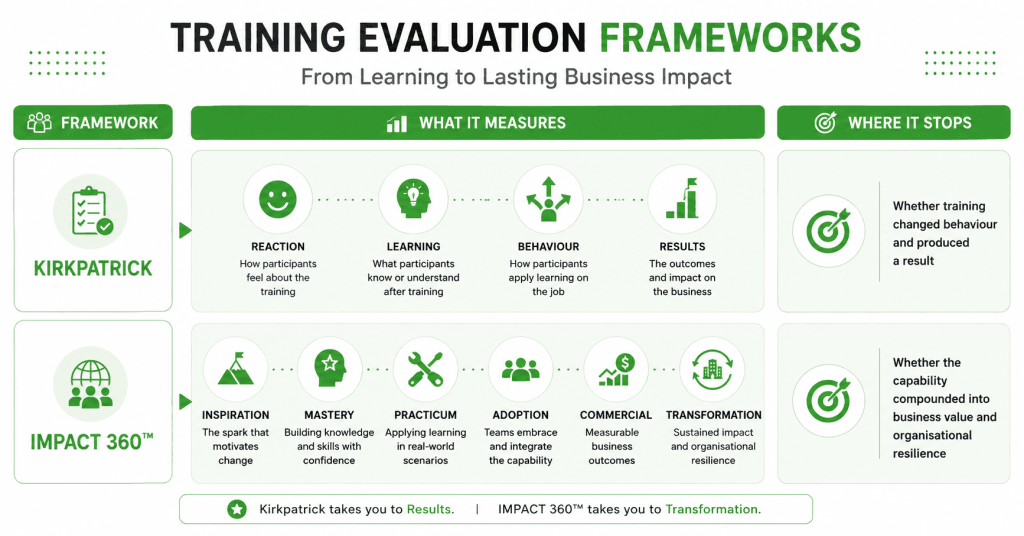
For a CHRO reporting to the board on AI investment, that difference matters. “94% completion rate” doesn’t answer whether GenAI changed anything. “Adoption embedded in daily work across three functions, tied to a measurable commercial outcome” does.
What changes when the gap closes
Close this gap and the conversation with the board shifts from “we rolled it out” to “here’s what it’s worth.” Employees stop quietly avoiding a tool they were never shown how to use for their actual job. Compliance risk drops because people know the boundary before they hit it, not after. And the next GenAI investment gets easier to justify, because you can point to adoption data instead of a licence count.
The organisations getting real value from GenAI right now aren’t the ones with the biggest announcement. They’re the ones that treated the rollout as the start of a capability-building programme, not the finish line of one.
What the next twelve months will test
The organisations that treated GenAI as an announcement will spend the next year explaining flat adoption numbers to their boards. The ones that treated it as a capability programme will be the ones with a defensible answer when someone asks what the investment actually returned. That’s the real dividing line, and it has very little to do with which tool anyone bought.
If you’re a CHRO trying to close the gap between what your leadership believes about AI readiness and what your workforce actually experiences, ProBits partners with enterprise teams to diagnose the role-by-role skill gaps behind a GenAI rollout and build a measurable upskilling path against them. Talk to ProBits about a workforce AI-readiness diagnostic for your organisation.